
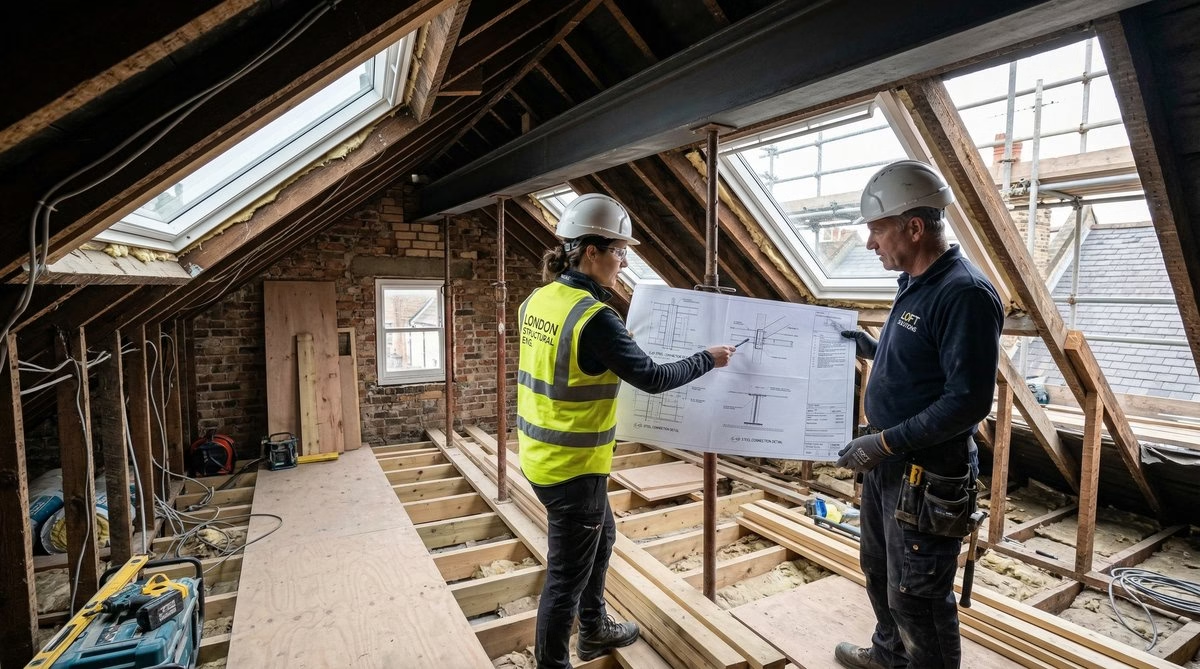
You received two or three quotes for your loft conversion, and they were all significantly higher than you expected. Now you want to understand why — and whether the difference between a £35,000 quote and a £60,000 quote for what looks like the same project is explained by genuine cost factors or by someone padding their margin. Understanding loft conversion cost steel beam structural engineer pricing in London — where labour rates, material lead times, and design complexity all run above the national average — is the key to reading a quote intelligently and understanding when a higher price is justified.
Why loft conversion quotes are inherently hard to compare
Unlike a kitchen installation or a bathroom refurbishment — where material specifications and scope are relatively easy to standardise — a loft conversion involves a sequence of technically complex, interdependent decisions. The structural approach, roof form, staircase position, dormer type, and glazing specification all affect the final cost in ways that make a headline figure almost meaningless without the detail behind it.
When you receive a quote, you need to understand what it includes and — more importantly — what it excludes. Common exclusions that inflate the apparent price gap between competing quotes include:
- Structural engineer’s fees: some contractors include SE design fees in the quote; others don’t. The SE fees alone can be £1,500–£3,500 for a standard conversion.
- Steel supply and installation: the steel beams themselves and the cost of getting them into position (which often requires specialist equipment on London streets) can be quoted separately.
- Party wall surveyor fees: if your loft conversion is a hip-to-gable or involves works to a party wall, party wall fees can be £1,500–£3,000 on top of the build cost.
- Building regulations and planning fees: application fees and building control inspections vary and are sometimes excluded from base quotes.
- Finishes: some quotes are to a basic shell finish (boarded, insulated, plastered) while others include flooring, joinery, and decoration.
Before comparing quotes, always list what each one explicitly includes and request that contractors price to the same specification. A lower quote that excludes steels and SE fees is not a lower price — it’s an incomplete one.
Steels in loft conversions — what they are, why you need them, and what they cost
This is the single most significant variable in loft conversion cost in the UK. Not every loft conversion requires structural steel beams — but most do, and in London Victorian and Edwardian terraces, the steel requirement is almost universal.
Why steels are needed
The existing roof structure of most pre-1960s houses was not built to carry floor loads. It was designed to span from wall plate to ridge, distributing the weight of the roof covering onto the external walls. Converting the loft space to habitable use requires a new structural floor — and that floor must transfer its loads to the external walls or down through the house structure without relying on the old ceiling joists, which are typically undersized for floor loads.
The solution is one or more structural steel beams — typically either a ridge beam (replacing or supplementing the ridge board and eliminating the need for traditional rafters to be propped), spine beams (running along the length of the loft to support new floor joists), or a combination of both.
What steels cost — realistic London figures
- Single ridge beam (simple Velux conversion): £2,000–£4,500 including supply, fabrication, and installation. Crane or scaffold lift may be needed depending on street access.
- Spine beams for floor (terraced house): £3,000–£6,000 for a pair of spine beams with appropriate bearing plates and packing.
- Hip-to-gable steel frame: £4,000–£8,000 for the structural frame where the hipped roof end is removed and replaced with a gable, including the new gable structure.
- Full dormer steelwork: £5,000–£10,000+ for a rear dormer that requires substantial structural support — particularly where there is no party wall to bear the steel ends and the load must be transferred down through the house frame.
These figures are for labour and materials only and assume reasonable access. London-specific constraints — a narrow Victorian terrace in a one-way street with no crane access, for example — can add £1,000–£2,500 to steel installation costs for specialist manoeuvring and rigging.
Tip: Ask your contractor specifically: “Are the steels designed and specified by a structural engineer, and are SE fees included in this quote?” If the answer is no or unclear, add the SE fee to your comparison price before deciding between contractors.
Structural engineer fees — what you’re paying for and why it matters
A structural engineer is not optional for a loft conversion with steels — building control will require structural calculations to be submitted and approved before any structural work begins. The SE’s role is to calculate the loads, specify the correct steel section sizes, detail the connections and bearing lengths, and issue a certificate that covers building control sign-off.
What SE fees cover
- Initial site visit and assessment: the SE needs to see the existing roof structure, the load-bearing walls, and the foundation arrangement before they can begin calculations. This is particularly important in London where Victorian terrace foundations vary considerably.
- Structural calculations: detailed load calculations in accordance with Eurocode 3 (steel design) and Eurocode 5 (timber), including floor loads, wind loads, and the transfer of loads through the existing structure.
- Specification drawings: dimensioned drawings showing beam positions, sizes, bearing details, and connections, issued to both the contractor and building control.
- Building control liaison: the SE typically liaises directly with the building control inspector to answer technical queries during the works.
Realistic SE fees in London (2026)
- Simple Velux conversion — no major structural changes: £800–£1,500. Calculations are straightforward; site visit is brief.
- Standard rear dormer on a Victorian terrace: £1,500–£2,500. This is the most common scenario in London and involves ridge beam, floor spine beams, and dormer framing calculations.
- Hip-to-gable conversion or L-shaped dormer: £2,000–£3,500. More complex structural arrangement with multiple load transfer paths to calculate.
- Complex or unusually large conversions: £3,000–£5,000+. Applies to large period properties with stone walls, unusual roof forms, or where the conversion requires significant work to existing load-bearing structures.
We always recommend that clients appoint the structural engineer directly — rather than through the contractor — to ensure the SE is working for your interests, not just to rubber-stamp the contractor’s preferred approach.
Staircase cost and position — the hidden budget driver
The staircase is the other variable that can move a loft conversion quote by £5,000–£15,000 in either direction, and it’s often underestimated in early budget discussions.
Why staircases are expensive
Building regulations require a loft conversion staircase to meet specific requirements: minimum headroom of 2 metres (or 1.9 metres for the staircase itself, subject to conditions), a minimum width, and a specific pitch range. In a typical London terrace, finding a position that meets headroom requirements — particularly on the landing above the first floor — is genuinely difficult and often requires creative design solutions.
- Standard straight flight (where space allows): £2,500–£4,500 for a quality timber staircase with balustrade and handrail, fitted.
- Space-saving alternating tread staircase: £3,500–£6,000. Often used where a standard flight can’t fit while maintaining adequate headroom. Building control must approve the use of an alternating tread in context.
- Bespoke turn or quarter-turn staircase: £5,000–£9,000+. Required where a straight flight is impossible due to space constraints. The bespoke joinery element significantly increases cost.
- Structural alteration to accommodate the staircase: if the ideal staircase position requires removing part of an existing partition wall or restructuring the first-floor layout, add £2,000–£6,000 for this work.
Tip: The staircase position is almost always the most constrained decision in a loft conversion. Resolve it early — before the structural engineer produces drawings and before the building regulations application is submitted — because changing it late in the design process can require expensive revisions to both.
The London pricing reality — why costs are higher than national averages
National average loft conversion cost guides typically quote figures between £25,000 and £45,000 for a standard dormer conversion. In London — particularly Zones 1–3, inner south London, and the inner suburbs — the realistic range for a complete, well-specified conversion in 2026 is £45,000–£75,000. Here’s why the premium is real and justified:
- Labour rates: skilled construction labour in London commands a significant premium over the national rate. A bricklayer, carpenter, or roofer working in London Zone 2 earns 25–40% more per day than the same tradesperson outside the M25.
- Access and logistics: London’s dense street layout, parking restrictions, and lack of storage space on site add cost to every trade. Scaffold erection, steel delivery, skip hire, and material storage all cost more in central and inner London than anywhere else in the UK.
- Building control and planning fees: London borough fees for building regulations applications and planning applications are not higher than elsewhere, but the time cost of navigating some London boroughs — which have more complex requirements and longer determination periods — increases the professional fees component.
- Party wall costs: London has the highest density of terraced houses in the UK, meaning the highest proportion of loft conversions involve party wall issues. These costs add a reliable £1,500–£3,000 to most London projects.
- Specification expectations: London homeowners generally expect higher-specification finishes — velux roof windows rather than budget rooflights, oak balustrades rather than softwood, underfloor heating rather than a single radiator. These specification upgrades are appropriate for the value of London property but add cost.
How Fixiz approaches loft conversion pricing
We provide itemised quotes that break out the steel costs, SE fees, staircase specification, and finish level — so you can see exactly what drives the total and make informed decisions about specification. We don’t believe in headline prices that bury costs until the contract stage.
For every loft conversion project, our process begins with a free site assessment where we evaluate roof structure, headroom, staircase options, and structural requirements before any design work begins. This means our initial budget guidance is based on what your specific loft actually requires — not on a generic per-square-metre rate.
We work with a panel of independent structural engineers with whom we have established relationships and agreed fee structures. We can introduce you to your SE directly, or manage that relationship on your behalf as part of our full project management service.
Frequently asked questions
Do all loft conversions need structural steel beams?
Not all — but the majority of conversions in London Victorian and Edwardian terraces do. A simple Velux-only conversion of a house with a cut roof (as opposed to a trussed roof) may be achievable with reinforced timber joists rather than steels, depending on the span and the floor loading. A structural engineer must confirm this. Trussed roof conversions almost always require steels because the truss members perform structural functions that cannot simply be cut without replacement.
Can I use a steel beam from a salvage yard to save money?
No. Structural steels must be certified — typically CE-marked or UKCA-marked — and must match the structural engineer’s specification for section size, grade, and length. Using uncertified salvage steels will not pass building control inspection and creates a significant liability risk. The savings are minimal compared to the cost of a correctly specified new steel, which for a standard section can be £200–£600 for the steel alone.
Why does my loft conversion quote include VAT at 20% — isn’t construction zero-rated?
New residential construction is zero-rated for VAT. However, loft conversions — which are works to an existing residential property — are subject to VAT at the standard rate of 20% unless specific conditions apply (for example, certain works for disabled persons or properties that have been empty for more than two years). Most loft conversion quotes correctly include VAT at 20%.
How long does a typical London loft conversion take from start to finish?
From initial site assessment to practical completion, a standard London dormer loft conversion typically takes 16–24 weeks in total. Design and planning takes 4–8 weeks; building regulations application and party wall process 6–10 weeks; construction phase 6–10 weeks. Planning permission (if required) adds 8–10 weeks. Working backwards from a desired completion date is essential for project planning.
What’s the return on investment for a loft conversion in London?
In London’s property market, a well-executed loft conversion that adds a bedroom and en-suite bathroom typically adds 15–25% to the property’s value — on a £600,000 inner London house, that’s £90,000–£150,000 of added value against a project cost of £50,000–£70,000. The return on investment depends heavily on the quality of the conversion, the local market, and whether the additional room count moves the property into a different pricing bracket for its area.
Ready to move from confusion to construction? Get in touch with Fixiz today for a no-pressure chat about your project and the fastest route to full compliance.