
When homeowners plan a garage conversion party wall agreement shared wall project, one question comes up again and again: do I need to go through the Party Wall process just because the garage shares a wall with my neighbour? The answer depends on exactly what you’re proposing to do to that wall — and in many cases, the answer is no. Understanding the distinction will save you time, money, and an unnecessary letter to your neighbour.
What the Party Wall Act actually covers — and what it doesn’t
The Party Wall etc. Act 1996 applies to three types of work, set out in its three main sections:
- Section 1: new walls built on or at the boundary line between properties.
- Section 2: works to an existing party wall or party structure — such as cutting into it, raising it, underpinning it, or making it good after excavation.
- Section 6: excavation within 3 metres of a neighbouring building (or 6 metres, depending on depth), which could undermine the neighbour’s foundations.
The crucial phrase in Section 2 is “works to the party wall” — the Act is triggered by works that physically affect the shared structure, not by the fact that a shared structure exists nearby. Simply carrying out construction inside your own property, even immediately adjacent to a party wall, does not automatically bring the Act into play.
The standard garage conversion — why Party Wall usually doesn’t apply
A typical garage conversion involves the following works:
- Removing or replacing the garage door with a window or solid wall
- Installing insulation to floor, walls, and roof
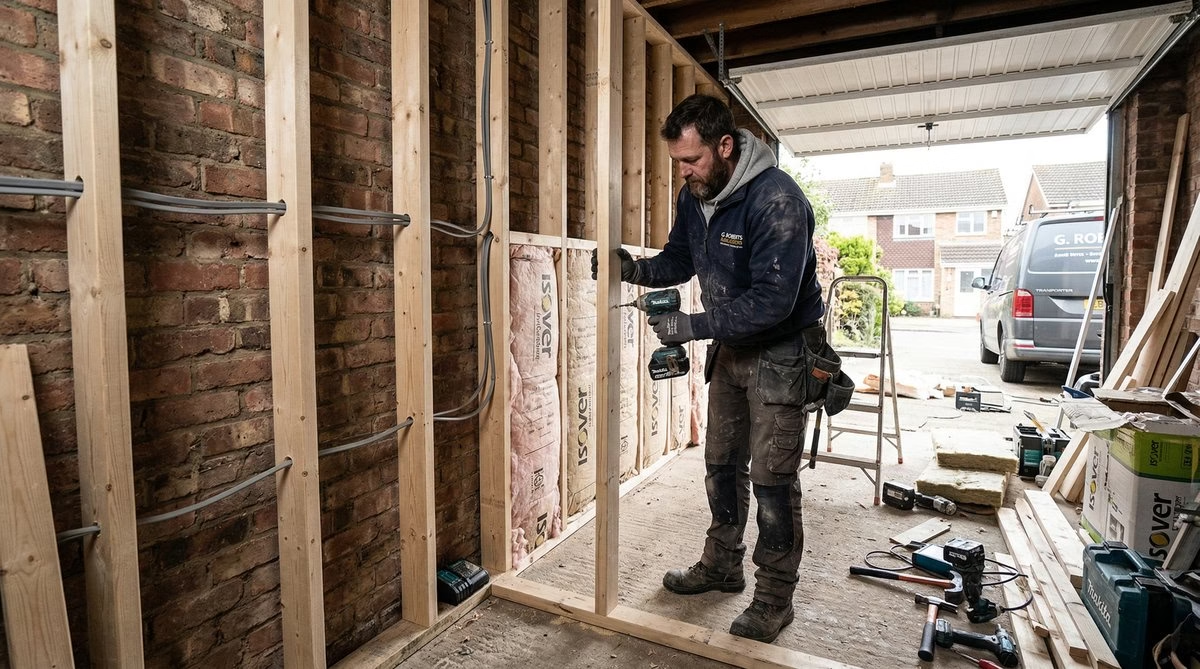
- Building a new stud-frame partition wall on the inside face of the party wall (not cutting into it)
- Fitting a floor finish, plasterboard lining, and electrics
- Adding or upgrading a heating source
In this standard scenario, nothing in the list involves cutting into, notching, removing, or loading the shared wall. You’re building in front of it, using it as a background — not altering it structurally. The Party Wall Act is not triggered by any of these works.
The stud wall point is worth emphasising. A timber stud frame or a lightweight metal-frame partition built on the inside face of the party wall — with insulation batts in the cavity and plasterboard on the room side — is entirely internal to your property. It places no load on the party wall and does not alter it in any way. This is standard practice in garage conversions and does not require party wall notices or an Award.
Tip: If you’re unsure whether your garage wall is actually a party wall — some garages have their own independent flank wall that happens to sit against the neighbour’s — check your title deeds and the land registry plan. A genuine party wall is shared ownership (each owner owns the half on their side of the centre line). An independent wall that merely adjoins a neighbour’s wall is not a party wall and the Act does not apply at all.
When Party Wall does apply to a garage conversion
There are specific circumstances where a garage conversion project will engage the Party Wall Act, even if the primary work is internal:
Cutting into the party wall
If the conversion design requires cutting into the shared wall — to insert a steel beam, to create a new door or window opening, or to install a structural lintel that bears on the wall — this is Section 2 work and party wall notices are required. The Act is triggered the moment you propose to make any physical alteration to the structure of the party wall itself.
Raising or extending the party wall
Some garage conversions involve raising the height of the garage roof to match the main house — particularly where a loft room over the garage is being incorporated into the living space. If this requires raising the height of the shared wall, Section 2 notices are needed.
Underpinning or excavating near the shared wall
Where a garage has inadequate or shallow foundations, a conversion may require underpinning the floor or walls to meet building regulations thermal performance requirements. Any excavation within 3 metres of the neighbour’s foundations at a depth greater than the neighbour’s foundations requires Section 6 notices.
New structural loadings on the party wall
If the design proposes to use the party wall as a bearing for new roof steels, new lintels, or any additional structural load, that loading constitutes a use of the party wall that requires notification under Section 2. This is less common in a standard garage conversion but can arise where the conversion involves a complex roof restructure.
The practical grey areas — and how to navigate them
Party wall law exists in a practical grey area between building regulations, planning law, and neighbour relations, and there are situations where the right course of action is not immediately obvious.
The “cutting into for cables and pipes” question
Many homeowners ask whether running electrical conduits, plumbing pipes, or service runs into the party wall triggers the Act. The answer is generally no — minor chasing into a party wall for services does not constitute a structural alteration. However, if you’re creating large openings or making substantial alterations to the fabric of the wall, seek advice from a party wall surveyor before proceeding.
The “just my half” question
Because each adjoining owner owns the half of the party wall on their side, some homeowners assume that works confined to their half don’t require notification. This is incorrect. Section 2 of the Act applies to works “to a party wall” — the legal definition of which includes works to either owner’s half.
The “friendly neighbour” temptation
Where neighbours have a good relationship, it’s tempting to have an informal chat, obtain verbal agreement, and proceed without formal notices. We strongly advise against this for works that technically require party wall notices. An informal agreement has no legal force — if damage occurs, or if relationships deteriorate, the building owner is left with no legal protection. A Party Wall Award, by contrast, creates a documented record that protects both parties.
Tip: Even where the Act does not apply — for example, a standard internal-only garage conversion — it’s worth sending a brief informal letter to your neighbour explaining the works, the expected start date, and duration. Good neighbour communication before noisy or disruptive works begin costs nothing and prevents a significant proportion of disputes before they start.
Building regulations and the party wall — two separate things
A common source of confusion is the relationship between building regulations and the Party Wall Act. They are entirely separate legal regimes.
Building regulations approval is required for a garage conversion regardless of whether the Party Wall Act applies. The building regulations set standards for structural integrity, fire resistance, thermal performance, ventilation, and electrical installation. A garage conversion must demonstrate compliance with these standards — through a full plans application or a building notice — whether or not there’s a shared wall involved.
The Party Wall Act sits alongside building regulations, not instead of them. A Party Wall Award does not waive building regulations requirements, and building regulations approval does not authorise any works that require party wall notification.
How Fixiz handles garage conversions with party walls
Our approach to every garage conversion begins with a thorough assessment of the existing structure — including the nature of the party wall, its construction, its condition, and whether the proposed works engage the Act. We establish this before design work begins, so that party wall notices can be served at the right time without delaying the project.
Where the Act applies, we co-ordinate the notice process and work with experienced party wall surveyors — including recommending the agreed surveyor route where appropriate to keep costs proportionate. Where the Act doesn’t apply, we make that clear in writing so that our clients can proceed with confidence.
Garage conversions are one of the most cost-effective ways to add living space in London and the south-east. Getting the legal and regulatory groundwork right at the start means the project runs smoothly, protects you legally, and adds value that survives scrutiny when you come to sell.
Frequently asked questions
My garage is semi-detached — is the garage wall definitely a party wall?
Not necessarily. In some semi-detached or terraced developments, each garage was built with its own independent flank wall, and the two walls sit immediately against each other but are separate structures in separate ownership. In other developments, the garages genuinely share a single party wall. Check your title deeds and, if in doubt, ask a solicitor or party wall surveyor to confirm the position from the title register.
Do I need to tell my neighbour I’m converting my garage, even if the Act doesn’t apply?
Legally, no — if no works to the party wall are proposed, there is no legal obligation to notify your neighbour. As a matter of good practice, however, we strongly recommend a brief courtesy notification before works begin, particularly where the construction phase will involve noise and disruption close to the boundary.
Can my neighbour object to my garage conversion through the Party Wall Act?
Only if the Act applies — i.e. only if your works engage one of the three sections. If the conversion is entirely internal with no structural works to the party wall, your neighbour has no standing under the Act to object. They may, of course, raise planning objections if the conversion requires planning permission, but that is a separate matter.
What if damage occurs to my neighbour’s property during the conversion?
If no party wall notices were required and none were served, you are still liable in nuisance or negligence for damage caused by your works. This is one reason why we recommend instructing a structural engineer to assess the condition of the shared wall before works begin, and why our contractors always carry adequate public liability insurance.
Does a garage conversion need planning permission if it’s attached to the house?
Most garage conversions do not require planning permission — converting an existing garage space to a habitable room does not alter the external footprint of the building and falls within permitted development for houses in most cases. However, planning permission is needed if the conversion involves significant external alterations, if the property is in a conservation area or is listed, or if an Article 4 Direction applies. Building regulations approval is always required, regardless of planning status.
Ready to move from confusion to construction? Get in touch with Fixiz today for a no-pressure chat about your project and the fastest route to full compliance.