
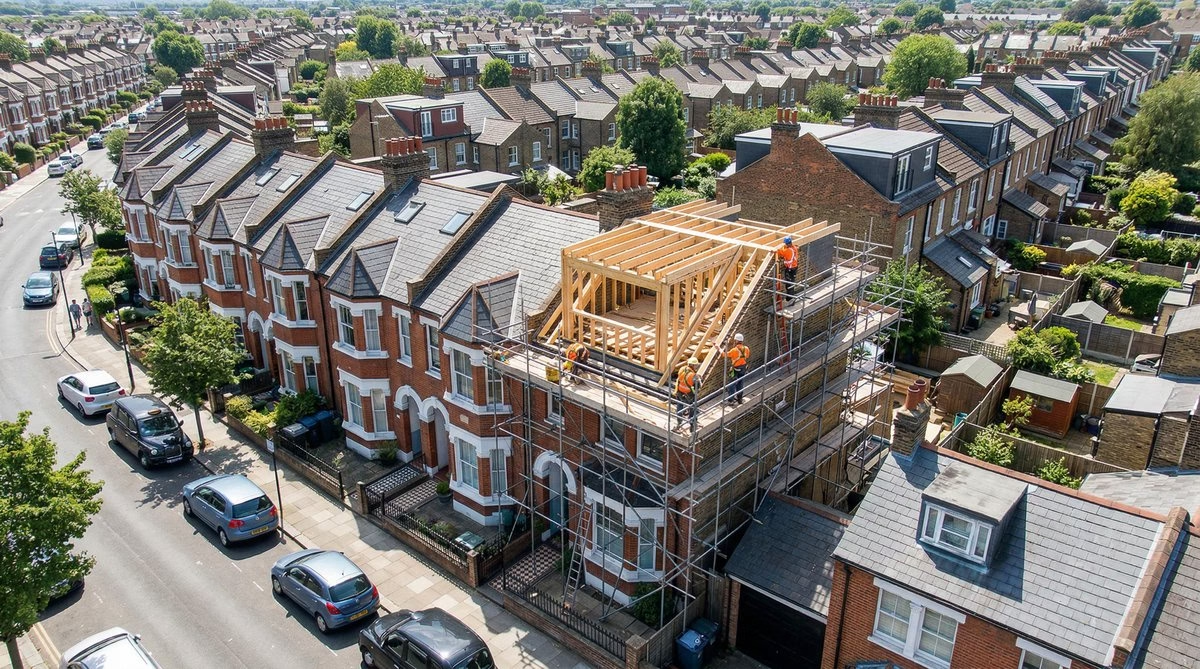
Every week, we speak to London homeowners who are about to start a loft conversion and have absolutely no idea that a legal 2-month clock needs to start ticking before the first brick is moved. The Party Wall etc. Act 1996 is one of the most misunderstood pieces of property law in the UK — and ignoring it is one of the most expensive mistakes you can make on a construction project. If you live in a terraced or semi-detached property in London, the chances are very high that your loft conversion will trigger a loft conversion party wall agreement — and yet countless homeowners sign building contracts and book builders without ever considering it.
In this guide, we break down exactly when you need a party wall agreement for a loft conversion, how the process works, what it costs in 2026, and — critically — how to factor the 2-month notice period into your project schedule so it never catches you off guard.
What Is the Party Wall Act 1996 — and why it matters
The Party Wall etc. Act 1996 is legislation that applies across England and Wales. Its purpose is straightforward: it creates a framework for resolving disputes between neighbouring property owners when one of them wants to carry out building works that could affect a shared (party) wall or structure.
Before the Act existed, disputes over shared walls had to go through the courts — expensive, slow, and adversarial. The 1996 Act introduced a practical alternative: serve your neighbour a formal notice, give them a chance to respond, and if there is any disagreement, appoint surveyors to produce a legally binding Party Wall Award that sets out exactly what work can be done, how it must be done, and what protections are in place for both properties.
For loft conversions, the Act is particularly relevant because almost every structural conversion in a terraced or semi-detached house involves cutting into, building on, or raising a party wall. The steel beams that support your new loft floor typically rest in pockets cut into the party wall. The new roof structure for a dormer often sits alongside and bears on the party wall. Even removing a chimney breast — which many homeowners do during a loft conversion — triggers the Act if the chimney is shared.
Tip: Under the Party Wall etc. Act 1996, if your loft conversion involves any work on a shared wall with a neighbour, you must serve a formal written notice at least 2 months before work starts. Skipping this step can result in injunctions and costly delays.
The three core rights under the Act
The Act grants you specific rights as a building owner, and it grants your neighbours specific rights in return:
- Your right to build: You can carry out necessary works to party walls — cutting in beams, raising walls, making good — even if your neighbour objects. The Act provides a mechanism to proceed regardless, as long as the process is followed.
- Your neighbour’s right to be protected: They can request a Schedule of Condition (a photographic record of their property before works begin) and claim compensation for any damage caused by your works.
- Both parties’ right to dispute resolution: If agreement cannot be reached, each party appoints a surveyor. Those surveyors produce a Party Wall Award — a legally binding document that protects everyone and allows the project to proceed.
On a recent loft conversion we completed in Tottenham — a mid-terraced Victorian house with two neighbours on either side — the homeowner called us two weeks before the planned start date asking why we had not begun. When we explained they had not yet served the party wall notice, they were completely floored. They had architects draw plans, got building regulations drawings, agreed a contract price, and booked skip hire. Nobody in the chain had flagged it. We had to push the entire start date back 8 weeks. That is the reality when the notice period is not built into the plan from day one.
One of the most common misconceptions is that a party wall notice is a formality — something you send the neighbour and they sign off on quickly. In reality, once your neighbour receives the notice they have 14 days to respond. If they do nothing, or if they dispute the works, a deemed dissent is triggered and surveyors must be appointed. The minimum timeline from serving notice to being able to start work is two months — and that is the best-case scenario.
Do you need a party wall agreement — a guide by property and conversion type
The most common question we get is: does my specific project actually need one? The answer depends on your property type and your conversion type.
- Terraced (mid) — Velux (roof lights only): Usually yes. Inserting structural floor joists into the party wall triggers the Act even without a dormer.
- Terraced (mid) — Rear dormer: Yes, both sides. You must notify both adjoining neighbours.
- Terraced (mid) — Mansard: Yes, both sides. This is the most structurally significant type and almost always affects both party walls.
- Terraced (end) — Rear dormer: Yes, one side. Only the one shared wall is affected.
- Semi-detached — Velux (roof lights only): Usually yes, for the same structural floor joist reason.
- Semi-detached — Rear dormer: Yes, one side.
- Semi-detached — Hip-to-gable plus dormer: Yes, one side.
- Detached — Any type: No. There are no shared party walls.
- Flat or maisonette — Any roof works: Yes, and the process is complex. Multiple notices may be required.
Why Velux conversions sometimes still require a notice
A common misconception is that Velux (rooflight) conversions — where you simply cut skylights into the existing roof slope — are safe from the Party Wall Act. This is not always true. Even though you are not building out a dormer, a Velux conversion in a terraced or semi-detached house almost always involves inserting steel floor joists into the party wall to create a structural floor. Those steel beam pockets cut into the party wall absolutely trigger the Act.
The only scenario where a Velux conversion might avoid party wall obligations is if your structural engineer designs the floor to bear on purpose-built steel columns rather than the party wall — but this is less common because it takes up floor space and adds cost.
Dormer loft conversions and the party wall
Dormer conversions are the most popular type of loft conversion in London, and they almost universally require a loft conversion party wall agreement. When you build a dormer, you are typically raising the rear part of the party wall to form the side cheeks of the dormer. You are also inserting ridge beams and structural steelwork that bear directly on the party walls. In a mid-terrace, both neighbours must receive notice.
On one job in Hackney — a narrow Victorian terrace — we had to raise both party walls by 600mm to achieve sufficient headroom for the dormer. Both neighbours had to be notified. One consented within two weeks; the other appointed their own surveyor. It took 10 weeks from the first notice before we could break ground. The homeowner had already taken unpaid leave expecting to be in before Christmas. We got it done, but the delay was entirely avoidable with proper planning.
Mansard loft conversions — the Party Wall Act at its most complex
Mansard conversions — particularly popular in conservation areas across inner London — involve the most significant structural changes of any loft conversion type. A mansard essentially replaces the rear roof slope with a near-vertical wall, dramatically increasing the usable floor area. Because of this, they almost always require raising the party wall upstand at roof level, cutting in substantial steelwork, and sometimes altering shared chimney stacks. In a terraced row, a mansard will trigger party wall obligations to both adjacent neighbours, and potentially to neighbours directly behind if foundations need strengthening.
Party wall surveyor costs in London 2026 — what to budget
The cost of the party wall process in London varies enormously depending on how cooperative your neighbours are, how many properties are affected, and whether you can agree on a single agreed surveyor or each party appoints their own. Here is a realistic breakdown of what to expect in 2026:
- Neighbour consents, one adjacent property: £700–£1,200. Covers notice preparation, Schedule of Condition, and consent documentation. Timeline: 2–4 weeks.
- Agreed surveyor, one surveyor for both parties: £1,000–£1,800. Covers notice, Schedule of Condition, and Party Wall Award. Timeline: 4–6 weeks.
- Separate surveyors, each party appoints own: £1,800–£3,500. You pay both sets of fees, plus the Award and inspections. Timeline: 6–10 weeks.
- Mid-terraced, two neighbours, agreed surveyor each side: £2,000–£3,500. Two Awards, two Schedules of Condition. Timeline: 6–10 weeks.
- Mid-terraced, two neighbours, separate surveyors both sides: £3,500–£5,500. Up to four sets of surveyor fees. Timeline: 8–14 weeks.
- Disputed, third surveyor required: £4,000–£7,000+. All of the above plus a third surveyor at £200–£300 per hour. Timeline: 10–16+ weeks.
As the building owner — the person carrying out the works — you are responsible for paying all surveyor fees, including those of any surveyor your neighbour appoints. The only exception is if your neighbour appoints a surveyor unnecessarily or without valid grounds, in which case a third surveyor may rule that the neighbour bears their own costs.
Some London surveyors offer fixed-fee party wall services, which can be significantly cheaper than hourly-rate firms. For a standard single-neighbour residential loft conversion, fixed-fee notices can be found from as little as £49–£150, and fixed-fee Awards from around £450–£900. Always ask for a clear fee structure upfront — Central London surveyors tend to charge more than those in outer boroughs due to higher demand.
Tip: Have an informal conversation with your neighbour before any formal paperwork. On a recent job in Lewisham, our client had already agreed to use a single agreed surveyor — a big cost-saver — but what really kept things smooth was that he had knocked on his neighbour’s door first, shown her the drawings, and explained the rough timeline. She consented within a week of receiving the formal notice. If you treat the party wall process as something done to your neighbour rather than with them, you are almost guaranteeing a more expensive and drawn-out process.
Flats, maisonettes and the Party Wall Act — the London complexity problem
If your property is a flat or maisonette in a converted terraced house — or if any of your adjacent neighbours own converted flats — the party wall process becomes considerably more complex. This is one of the aspects of London property law that catches homeowners most off guard.
Why flats create multiple adjoining owners
Under the Party Wall etc. Act 1996, any person with a legal interest in an adjoining property must receive a notice. In England and Wales, most flats are owned on a leasehold basis, meaning you have both a leaseholder (the occupier who owns the flat) and a freeholder (the company or person who owns the building). Crucially, both are considered owners under the Act if their lease is longer than 12 months — and long residential leases almost always are.
This means that if you are converting your loft in a terraced house and the property next door has been converted into two flats, you may need to serve party wall notices on the freeholder of the neighbouring building, the ground floor leaseholder, and the first floor leaseholder. That is three separate notices for one property. If your mid-terrace has converted flats on both sides, you could be looking at six or more notices before a single brick is laid. And if any one of those parties appoints their own surveyor, you are paying for all of them.
We once had a client whose neighbour had split their Victorian terrace into three flats. The freeholder was an offshore property company with a solicitor who was not inclined towards quick resolutions. Each of the three leaseholders also had to be served. By the time everyone had responded and surveyors had been appointed, the party wall process alone cost the homeowner just over £6,200 and delayed the project by four months — while the conversion itself took seven weeks. Check the neighbouring property’s ownership structure on the Land Registry before you do anything else.
If you are a leaseholder planning a loft conversion
If you own a maisonette or top-floor flat on a leasehold basis and want to convert the loft space, you face an additional layer of complexity. Before you even get to the party wall process, you will almost certainly need:
- A Licence to Alter from your freeholder: This is a condition of virtually every residential lease and grants permission for structural changes to the building.
- Confirmation of who owns the roof space: In many leases, the roof and roof void remain the freeholder’s property, not the leaseholder’s.
- Party wall notices served on the freeholder and any affected leaseholders: The freeholder must be notified under the Act as an adjoining owner for any works affecting the party structure, even if the work is above their flat.
Tip: Get Land Registry title information for all adjoining properties at the very start of the process — it is a small cost that prevents enormous surprises later.
The real project timeline — how the 2-month notice fits in
One of the most valuable things we can do as a London building company is show you the full, realistic timeline for a loft conversion from deciding you want this to sleeping in your new loft bedroom. The party wall notice period does not exist in isolation — it needs to slot into a sequence of activities, and the good news is that it can run in parallel with many of them if you plan correctly.
- Weeks 1–2 — Initial consultation and feasibility: Site visit, head height check, structural assessment. Confirm property type and identify party walls. Check Land Registry for neighbouring ownership — critical if neighbouring properties contain flats.
- Weeks 3–5 — Architect drawings and planning assessment: Architectural drawings prepared. Confirm if permitted development or planning permission is required. Structural engineer engaged for beam calculations.
- Week 6 — Serve party wall notices (do not delay this step): Notices served on all adjoining owners the moment drawings confirm party wall works are needed. The 2-month clock starts now. Neighbours have 14 days to respond. This is the most time-sensitive step in the entire project.
- Weeks 6–8 — Planning permission (if required): Planning application submitted, running concurrently with the notice period. Local planning authorities typically take 8 weeks. Dormer conversions in inner London may need full planning, especially in conservation areas.
- Weeks 6–14 — Party wall process runs concurrently: If consent is given, proceed after the 2-month notice expires. If disputed, surveyors are appointed, a Schedule of Condition is conducted, and a Party Wall Award is drafted. This entire process runs in parallel with planning and building regulations.
- Weeks 8–10 — Building regulations application: Full plans submission to building control. Structural engineer drawings submitted. Initial inspection scheduled for start of works.
- Weeks 10–12 — Contractor finalised, materials ordered: Final contract signed, build programme confirmed, scaffold booked, structural steelwork ordered (typically 3–4 weeks lead time).
- Weeks 14–22 — Construction phase (6–8 weeks typical): Scaffold erected, structural steels installed, dormer and roof works, first fix electrics and plumbing, insulation, boarding, second fix, plastering, decoration, staircase, final building control sign-off.
- Week 22+ — Completion and building control certificate: Snagging complete, building control final inspection, completion certificate issued, scaffold struck.
Tip: Most homeowners do not serve party wall notices until they have already signed a build contract and are two weeks from start. By then they have committed financially and emotionally. Serving the notice at Week 6 of the planning process — not Week 12 of the build run-up — means the legal process runs in parallel rather than extending your overall programme.
Free party wall notice template for a loft conversion
You are legally permitted to serve a party wall notice yourself — you do not have to hire a surveyor for this step, though you may want one to check it before serving. The notice must include specific information to be legally valid. Here is a template you can adapt. Replace all items in [BRACKETS] with your specific details.
Party Wall Notice — Section 2 Notice (Works to Existing Party Wall)
[Your Full Name]
[Your Address]
[Your Email / Phone]
[Date]
To: The Owner(s) of [Neighbour’s Full Address]
PARTY WALL ETC. ACT 1996 — NOTICE OF PROPOSED WORKS
I, [Your Full Name], as owner of [Your Property Address], hereby give you notice under Section 2 of the Party Wall etc. Act 1996 of my intention to carry out the following works:
Proposed Works: Loft conversion to the above property, including: insertion of steel floor joists into the party wall between our properties at [approximate height]; [and/or: raising of the party wall by approximately X mm to form the cheeks of a rear dormer]; [and/or: cutting of padstone/spreader plate pockets into the party wall to receive structural steelwork]. Works as shown on the attached drawings prepared by [Architect Name] dated [Date].
Proposed Start Date: [Date — must be at least 2 months from the date of this notice]
You have 14 days from the date of this notice to respond. You may: (a) consent to the works by signing and returning the enclosed acknowledgement form; (b) dissent, in which case you and I must each appoint a surveyor, or we may jointly appoint an agreed surveyor; or (c) fail to respond within 14 days, which will be treated as a dissent.
Signed: _________________________
Date: _________________________
Tip: This template is provided as a guide only. For complex projects, properties with multiple adjoining owners, or any situation where relations with a neighbour are strained, we strongly recommend using a qualified party wall surveyor to serve the notice. Contact us at Fixiz and we can refer you to trusted London-based party wall surveyors.
How Fixiz keeps your loft conversion on track
We manage loft conversions in London every day, and the party wall process is something our team handles as a matter of course. Here is what we do to make sure it never derails your project:
- Early identification: We confirm whether party wall obligations apply at the feasibility stage — not once the build contract has been signed.
- Notice timing: We advise you to serve notices the moment architectural drawings confirm party wall works, typically at Week 6 of the design process, so the legal period runs in parallel with everything else.
- Surveyor referrals: We work with a network of cost-effective, trusted party wall surveyors across London and can coordinate referrals on your behalf.
- Neighbour communication: We help you approach your neighbours informally before any formal paperwork goes out — experience tells us this single step makes more difference to cost and timeline than anything else.
- Land Registry checks: For any project where neighbouring properties may contain flats or leasehold titles, we flag this early so you know exactly how many notices are needed.
Final thoughts — don’t let the party wall process surprise you
The Party Wall etc. Act 1996 is not something to fear. It is actually a well-designed piece of legislation that protects both you and your neighbours. The problem is not the law itself — it is that nobody tells first-time homeowners about it until it is too late to plan for it properly.
The 2-month notice period is completely manageable if you build it into your project plan from the start. Serve your notices the moment your architectural drawings confirm party wall works are needed — typically around Week 6 of the design process — and the legal period will be running in parallel with your planning application and building regulations drawings. Done this way, it adds zero time to your overall project.
The key takeaways from this guide:
- Terraced and semi-detached homeowners: Assume you need a loft conversion party wall agreement and plan for it. You almost certainly do.
- Detached homeowners: You are almost certainly exempt, but confirm with your structural engineer.
- Flat owners and anyone with converted flats next door: Get Land Registry title details for all neighbouring properties before you do anything else — the ownership structure determines how many notices you need to serve.
- Have the informal chat with your neighbour first: It is free, builds goodwill, and often results in a straightforward consent that saves thousands.
- Budget £900–£5,000 for the party wall process, depending on complexity. Factor this into your total project budget from day one.
Frequently asked questions
Can my neighbour stop my loft conversion by refusing to consent to the party wall notice?
No. This is one of the most important things to understand about the Party Wall Act 1996: your neighbour cannot use it to permanently block your project. Even if they refuse consent, all this triggers is the appointment of surveyors. The surveyors produce a Party Wall Award — a legally binding document — that allows the work to proceed with protections in place for both properties. Your neighbour can raise legitimate concerns through the surveyor process, which may result in certain conditions being placed on how the works are carried out, but they cannot veto the project entirely. They can, however, object via the planning process if planning permission is required — that is a separate avenue.
What happens if I start work without serving a party wall notice?
Starting party wall works without a notice is illegal, and the consequences can be severe. Your neighbour can apply to the courts for an injunction to stop the works immediately — which can happen even mid-project, leaving you with an exposed structure and a halted site. You could also be liable for any damage to their property and face a damages claim without the protection of a pre-works Schedule of Condition. Courts have little sympathy for building owners who ignore the Act, and legal costs in injunction proceedings can easily run to five figures.
Do I need a party wall agreement for a Velux loft conversion?
Possibly yes. Even though Velux conversions do not involve building a dormer structure, they almost always require inserting structural floor joists or steel beams into the party wall to create a usable floor. This work directly triggers the Party Wall Act. The only exception is if your structural engineer designs the floor to bear on purpose-built columns rather than the party wall — but this is not always practical or cost-effective. Always check with your structural engineer and confirm whether party wall works are required for your specific design before assuming a Velux conversion means no notice is needed.
How long is a party wall notice valid for?
A party wall notice is valid for 12 months from the date it is served. This means you must begin the notifiable works within 12 months of serving the notice, or the notice expires and you would need to start the process again. This is why we advise against serving notices too far in advance — particularly if there is any chance your project timeline might slip by more than a year.
Can I use an agreed surveyor to keep costs down?
Yes, and this is almost always the best option if your neighbour agrees. An agreed surveyor is a single impartial professional appointed by both you and your neighbour jointly. Because only one set of fees is involved, costs are typically 30–50% lower than if each party appoints their own. The agreed surveyor must act impartially for both parties, so both sides are protected. The key is getting your neighbour’s agreement to this approach upfront — ideally before any formal process begins. Mention it in your initial informal conversation with them.
Does the Party Wall Act apply to flats and apartments?
Yes, and the situation is often more complex than for houses. If the property next door contains multiple flats, you may need to serve notices on the freeholder and each leaseholder with a lease longer than 12 months. For a converted terraced house containing three flats on either side, a mid-terrace property owner could need to serve up to six separate notices before starting work. If you are a leaseholder yourself, you will also typically need a Licence to Alter from your freeholder in addition to completing the party wall process with your neighbours.
How much does a loft conversion party wall agreement cost in London in 2026?
In London in 2026, budget between £900 and £5,000 for the party wall process on a standard residential loft conversion, depending on how many neighbours are involved and whether surveyors are required. The best-case scenario — one neighbour who consents and agrees to a single surveyor — typically costs £700–£1,200. The worst case — two neighbours both appointing separate surveyors, with a third surveyor needed to resolve a dispute — can exceed £5,000–£7,000. Early, informal communication with your neighbours before serving any formal notice is the single most cost-effective thing you can do.
Does the Party Wall Act apply in Scotland?
No. The Party Wall etc. Act 1996 applies only in England and Wales. Scotland has its own separate legal framework for dealing with shared structures under common law and the Tenements (Scotland) Act 2004. If you are in Scotland, seek advice from a Scottish solicitor or surveyor familiar with that regime.
Ready to move from confusion to construction? Get in touch with Fixiz today for a no-pressure chat about your loft conversion and how we handle the party wall process for you.