Physical address:
128 City Road, EC1V 2NX, London,UK

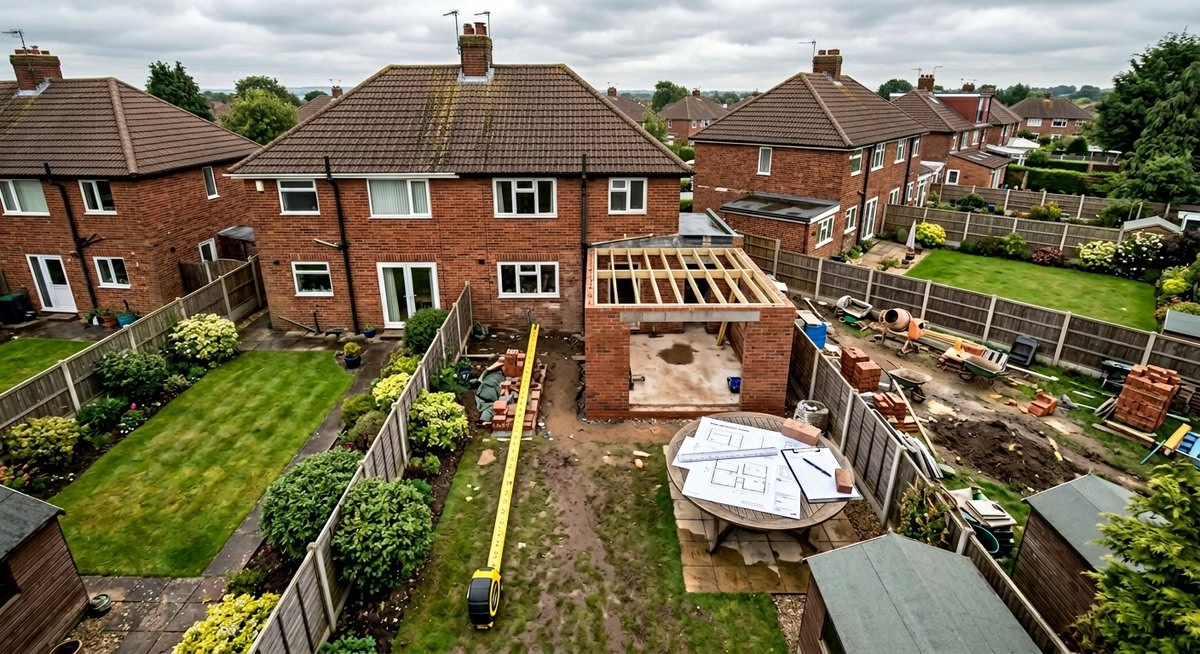
You have heard that you can build a 6 metre rear extension permitted development style — no full planning application, just a quick form and you are away. Perhaps your neighbour did exactly that last year. But then you discover terms like “prior approval,” “original rear wall,” and “total enlargement” — and the picture gets murky fast. At Fixiz, we deal with this confusion weekly. This article unpicks the actual rules so you can work out which route applies to your situation.
Standard PD limits vs the larger home extension route — what is the difference?
There are two distinct tiers of single-storey rear extension under Part 1, Class A of the General Permitted Development Order. Getting them mixed up is where most of the “6 metre” confusion begins.
Tier one — standard permitted development. Under basic PD, a single-storey rear extension can project up to 3 metres from the original rear wall on a semi-detached or terraced house, or up to 4 metres on a detached house. Meet all the other Class A conditions — height no more than 4 metres, materials matching the existing house, no more than 50 per cent curtilage covered — and you do not need to notify anyone. No planning application, no prior approval form, no neighbour consultation. You simply build (though you still need Building Regulations approval, and we strongly recommend getting a Lawful Development Certificate for your records).
Tier two — the larger home extension (prior approval route). If you want to go further — up to 6 metres for a semi or terrace, or up to 8 metres for a detached house — you are still technically within permitted development, but you must submit a prior approval application to your local planning authority before work starts. This triggers a formal neighbour consultation, and the council assesses the impact on adjoining properties. The extension must still be single-storey and no taller than 4 metres, and the property must not be on Article 2(3) land (conservation areas, AONBs, National Parks) or a site of special scientific interest.
We regularly meet homeowners who assume the 6 metre allowance works exactly like the 3 metre one — just bigger. It does not. The prior approval step is a genuine process with a real timeline and the possibility of refusal. Equally, we see people who think “prior approval” means full planning permission. It is neither — it is a narrower assessment focused on the impact on adjoining amenity.
How to measure the “original rear wall” — and why existing extensions change everything
The single most important measurement is how far your new extension projects beyond the original rear wall. The government’s technical guidance defines “original” as the building as it existed on 1 July 1948, or — if your house was built after that date — as it was when first constructed. Any extension added after the house was built is not part of the original house, regardless of how long it has been there or who built it. The rear wall is specifically the wall or walls directly opposite the front of the house. Where the original rear wall is stepped — common on Victorian houses with a rear outrigger — each section counts separately, and your extension must comply measured from whichever rear wall it projects beyond.
Tip: Measurement runs from the base of the original rear wall to the outer edge of the new extension wall, excluding guttering and barge boards.
Under paragraph (ja) of Class A, when you join a new extension to an existing one, the total enlargement — both extensions combined — must fall within the permitted limits. You cannot measure your new bit in isolation. For example, if your semi already has a 3 metre rear extension and you want to reach 6 metres total, the maths seems fine — but the combined structure must also satisfy every other condition: height limits, boundary setbacks, 50 per cent curtilage rule, and more. If the existing extension already reaches 6 metres, any joined addition that pushes further is outside PD altogether and needs full planning permission.
In our experience at Fixiz, the “existing extension” scenario catches more homeowners off-guard than any other. People see the 6 metre headline and assume it is fresh allowance on top of what exists. It is not — it is the total distance from the original rear wall, including anything already built.
Why your neighbour’s extension does not guarantee yours — and choosing the right route
“But number 42 built a 6 metre extension — surely I can do the same?” We hear this constantly at Fixiz, and it can be misleading for several reasons:
- Different starting points: Your neighbour’s original rear wall may be in a different position. Even on identical-looking semis, previous alterations shift where the original rear wall sits.
- Different extension history: If your house already has an extension and theirs did not, your cumulative allowance is reduced. Their clean slate gave them the full 6 metres; your existing 2 metre conservatory eats into that budget.
- Different curtilage coverage: They may have a larger garden, keeping them under the 50 per cent limit that your smaller plot would breach.
- They may have used full planning: A granted planning permission can allow sizes and configurations that PD would not — but it required a formal application that does not transfer to your property.
Tip: Check your local authority’s planning portal by address to see what route a neighbour actually used — PD, prior approval, or full planning — and what conditions were attached.
Once you know what you want to build and what already exists, pick the correct route. If your extension is within the standard PD limits (3 metres for a semi/terrace, 4 metres for detached), apply for a Lawful Development Certificate — it is not legally required, but it protects you when selling or remortgaging. If the extension projects beyond the standard limits but within 6 or 8 metres, you must submit a prior approval application (currently £240, rising to £249 from April 2026). And if you exceed the 6/8 metre limit, are on designated land, breach any other Class A condition, or your PD rights have been removed, you need full planning permission (currently £528, rising to £548 from April 2026).
Already have an older extension and want to add more? Here is what to consider
This is the scenario that causes the most headaches — and the one this article exists to address. Before designing anything new, establish whether the existing extension is lawful. There are three possibilities:
- Built with permission or under PD with records: Straightforward — factor its dimensions into the total enlargement calculation.
- Built without permission but immune from enforcement: Under the old four-year rule (replaced by a ten-year rule from 25 April 2024), an unauthorised extension could become immune after four continuous years. If yours was completed before 25 April 2020 and has remained in place since, it may still qualify under transitional provisions. Apply for a Certificate of Lawfulness for Existing Development (CLEUD) to confirm its status.
- Built without permission and not yet immune: The existing extension is technically unlawful and the council could take enforcement action. Adding a new extension on top creates serious risk — regularise the existing situation first, either through a CLEUD or a retrospective planning application.
Once the old extension is confirmed as lawful, measure its projection from the original rear wall, add the proposed new extension, and check the combined total against the 6 or 8 metre limit plus all other Class A conditions. Note that the total enlargement rule under paragraph (ja) applies only when the new extension is joined to the existing one. A freestanding structure would be assessed separately — likely as an outbuilding under Class E with its own rules and limits.
One option we raise with clients at Fixiz: if the old extension is in poor condition, demolishing it entirely resets the rear wall to the original position and gives you the full PD allowance to work with. This can be more cost-effective than trying to work around a structure that has already consumed your permitted development headroom.
The 42-day neighbour consultation — how it actually works
If you are using the larger home extension prior approval route, the 42-day timeline is central. Here is the step-by-step process:
- You submit your prior approval application to the local planning authority with the required documents and fee. You need a written description of the extension (projection, maximum height, eaves height), a site plan, addresses of adjoining properties, and your contact details.
- The council writes to adjoining neighbours. The notification letter includes a description of the proposed extension plus the deadline for representations. Neighbours get a minimum of 21 days to respond (excluding public holidays).
- If no objections are received, the council typically confirms that prior approval is not required and you can proceed.
- If objections are received, the council assesses whether the impact on the amenity of adjoining properties is acceptable. This is narrower than full planning — the council looks at amenity impact (light, overshadowing, sense of enclosure), not design or character of the area. They may request further information from you to address concerns.
- A decision is issued — prior approval not required, granted (with or without conditions), or refused.
- If no decision within 42 days of the council receiving your complete application, the development is deemed approved and you may proceed.
Tip: Do not start building before you have written confirmation — or before the 42 days have elapsed. Starting early is a breach, and because the prior approval process cannot be done retrospectively, you would need a full retrospective planning application to regularise the work.
We have seen the 42-day deemed approval work in our clients’ favour, particularly with busy London boroughs that struggle to process applications on time. But we always advise treating it as a backstop rather than a strategy — a council that did not get round to deciding may still investigate the finished extension if it does not comply.
How Fixiz keeps your rear extension on track
The “6 metre” question is rarely as simple as a single number. It depends on what you are starting with, what has been built before, and which route through the system fits your circumstances. At Fixiz, we help homeowners cut through the noise in several practical ways.
- Site assessment and PD audit: We identify the original rear wall position, check for existing extensions (including those added by previous owners), and calculate your remaining PD allowance before any design work begins. This single step prevents the most common and most expensive mistake — designing an extension that turns out to exceed the total enlargement limit.
- Route selection and cost comparison: We determine whether standard PD, prior approval, or full planning is the right path for your specific project — and explain the cost, timeline, and risk implications of each so you can make an informed decision rather than guessing.
- Application preparation: Whether it is a Lawful Development Certificate, a prior approval submission, or a householder planning application, we ensure all documentation is complete and accurate from day one. Incomplete submissions lead to delays or outright refusal, and we have seen that happen to homeowners who submitted without professional support.
- Neighbour consultation support: For prior approval cases, we help you understand what neighbours can and cannot object to and prepare the factual evidence needed to demonstrate that your extension will not harm adjoining amenity.
- Building Regulations coordination: Regardless of the planning route, your extension needs Building Regulations approval. We coordinate this in parallel so your project is not held up by sequential applications.
Getting the groundwork right before you commit to a design saves real money. We have worked with homeowners who came to us after spending thousands on architectural drawings for an extension that could never have been built under PD — all because nobody checked the total enlargement calculation first. A short initial consultation avoids that entirely.
Frequently asked questions
Can I build a 6 metre rear extension without any application at all?
Not on a semi-detached or terraced house. A 6 metre projection exceeds the standard PD limit of 3 metres, so it requires a prior approval application under the larger home extension provisions. You must apply to the council and wait for the neighbour consultation to complete — or for 42 days to elapse — before starting work.
Does my existing conservatory count as part of the total enlargement?
Yes, if your new extension will be joined to the conservatory. Under paragraph (ja), the total enlargement — your proposed extension plus any existing extension it connects to — must fall within all the PD limits. If the conservatory already projects 3 metres and you join a new extension to it, you only have 3 more metres before hitting the 6 metre cap on a semi or terrace.
What can neighbours actually object to under prior approval?
The council’s assessment is limited to the impact on the amenity of adjoining premises — typically loss of light, overshadowing, and sense of enclosure. It does not cover design, appearance, or character of the area. Objections on those broader grounds carry no weight in a prior approval decision.
Can I demolish an old extension and rebuild a bigger one under PD?
If you demolish the existing extension entirely, you reset the rear wall to the original position and can measure your new extension from there. This can be a practical route when an old extension has consumed your PD allowance but is in poor condition anyway. The replacement must still meet all Class A conditions, so confirm the approach with your local authority before committing.
Ready to move from confusion to construction? Get in touch with Fixiz today for a no-pressure chat about your project and the fastest route to full compliance.