Email:
info@fixiz.co.uk
Physical address:
128 City Road, EC1V 2NX, London,UK

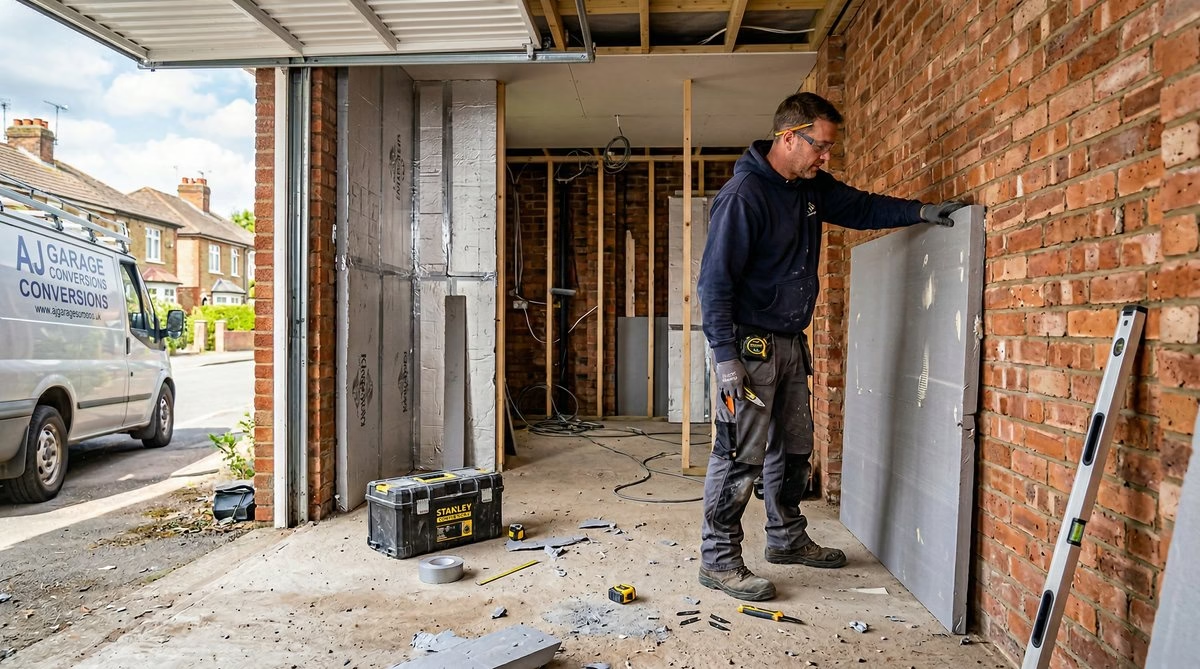
Every week we speak to homeowners who’ve started a garage conversion — or worse, already finished one — without getting proper garage conversion building regulations UK approval. The belief is always the same: “It’s just a garage, it’s all internal, how complicated can it be?” The answer is: more complicated than most people expect, and the consequences of getting it wrong range from a stressful enforcement notice to a property sale falling through years down the line.
In our experience converting garages across North London — from integral garages in Enfield to detached outbuildings in Highgate — building regulations are the one area where cutting corners costs you more in the long run than simply doing it right first time. This article is our complete 2026 compliance checklist. We’ve mapped every Approved Document that applies to a garage conversion, included the U-value targets your inspector will check, broken down what building control actually costs in London, and covered the Lawful Development Certificate step that an alarming number of builders and homeowners skip entirely.
Whether you’re planning the project yourself or hiring a builder and want to know what questions to ask, this is the checklist that keeps your project legal, your conversion comfortable, and your future property sale clean.
Key 2026 fact: Planning permission is not usually required for a standard garage conversion — but building regulations approval is always mandatory, even if the work is entirely internal. These are two completely separate processes. Do not confuse them.
Most homeowners know they may need planning permission for building work. What surprises them is learning that for a garage conversion, planning permission is usually not required at all — but building regulations approval is non-negotiable every single time. The distinction matters enormously.
Planning permission deals with the visual impact of your development on the area around it: the look of the building, its effect on neighbours, its relationship to the street. Building regulations are about whether the building is safe and functional: structural stability, fire safety, thermal performance, ventilation, electrical safety. A conversion that passes planning but fails building regulations is still an illegal structure. And a conversion completed without building control sign-off is, legally speaking, unauthorised building work — even if it looks immaculate.
The practical consequences are serious. When you sell the property, your conveyancing solicitor will ask for the building regulations completion certificate. Without it, you face one of three awkward situations: paying for a retrospective regularisation application (which costs the same as a standard application and involves an inspector checking work that may now be buried behind plasterboard), negotiating an indemnity insurance policy with a nervous buyer, or — in the worst cases — being required by an enforcement notice to open up walls and demonstrate compliance. We always tell our clients: the cost of doing building regulations properly is a rounding error compared to the cost of an enforcement action or a collapsed property sale.
According to the Planning Portal, the conversion of a garage into habitable space will normally require approval under the building regulations in all but the most minor non-habitable cases. The only real exception is converting a garage into non-habitable storage — and even then it is worth checking with your local building control team before starting.
The Building Regulations 2010 (as amended) are delivered through a series of Approved Documents, each covering a different aspect of construction performance. For a garage conversion building regulations UK project, seven Approved Documents are directly relevant. Here is your action-by-action checklist for 2026 compliance.
Tip: Use an electrician registered with a Competent Person Scheme such as NICEIC, NAPIT, or ELECSA. They can self-certify their own work, which removes one item from your building control submission and speeds up the final sign-off process considerably.
One project we completed in Enfield last year taught us just how important it is to get U-value calculations right before ordering insulation. The client had already sourced 75mm PIR boards for the walls, confident they’d be adequate. When we ran the calculation, the 75mm boards against that particular single-skin brick wall came out at 0.22 W/m²K — above the 0.18 target. We had to switch to 90mm boards. The difference in cost was small; the potential problem with building control would have been significant.
Here are the maximum U-value targets that apply to garage conversion building regulations UK projects (existing dwellings) under the current Approved Document L:
Tip: Always calculate U-values for your specific wall buildup rather than relying on generic specifications from insulation manufacturers. The finished U-value depends on the brick thickness, mortar joints, any existing plaster, the insulation board, the air gap (if any), and the plasterboard finish. Free online U-value calculators from manufacturers such as Kingspan and Celotex are perfectly adequate for this purpose.
One of the most consistent gaps in online guidance about garage conversion building regulations UK is a realistic breakdown of what building control actually costs. The fee depends on which route you take, the size of your garage, and whether you use your local council’s building control service or a private approved inspector.
As a general figure, building control fees for a garage conversion in 2026 range from £360 to £1,200. Here is the breakdown by scenario:
Note that building control fees do not include structural engineer fees (typically £300–£700 for calculations and drawings) or architectural drawings (£500–£1,500 if required). In London, expect to pay at the higher end of all these ranges — labour and professional fees typically run 15–25% above the national average.
Here is the step that a surprising number of builders — and even some architects — fail to mention to their clients. Even when a garage conversion falls entirely within Permitted Development rights and no planning application is needed, you should still apply for a Lawful Development Certificate (LDC) from your local planning authority.
An LDC is not the same as planning permission. It is a formal written confirmation from your council that your development is lawful — that it correctly falls within Permitted Development and no planning application was required. It costs between £124 and £310 in England as of 2026 and takes approximately six to eight weeks to process.
Why does it matter? When you sell the property, your conveyancing solicitor will ask for evidence that all building work was properly authorised. Without an LDC, you are relying on the buyer’s solicitor accepting the absence of a planning application as sufficient evidence — which many will not. The same issue arises with remortgaging. We had a situation last year where a client in Barnet tried to sell their home with a perfectly compliant garage conversion completed two years earlier. No LDC had been obtained. The buyer’s solicitor flagged it, negotiations stalled for three weeks, and the client ended up taking out indemnity insurance at a cost of £250 — all of which could have been avoided for the price of an LDC application at the time of the conversion.
Much of the guidance available online is written for a national UK audience. London homeowners face some additional complications worth understanding before starting any garage conversion building regulations UK project.
An Article 4 Direction is a planning restriction that removes specific Permitted Development rights from properties in a defined area. In London, Article 4 Directions are more prevalent than anywhere else in England — affecting conservation areas, areas of outstanding architectural importance, and in some cases entire boroughs’ housing stock. If your property falls within an Article 4 area, the automatic assumption that a garage conversion is Permitted Development may be wrong. In that scenario, a full planning application would be required, not just an LDC.
Checking your Article 4 status takes two minutes: search your local council’s planning policies map online, or call the planning duty officer. We always check this before we quote for any London conversion project. It has saved our clients significant expense on multiple occasions.
Approximately 30% of London’s housing stock sits within a designated conservation area. In a conservation area, any alteration to the external appearance of a building — including replacing the garage door with a new window or wall — requires materials to match the existing building. In some cases, a full planning application is required regardless of whether the work would otherwise be Permitted Development. Always check with your local authority before specifying external materials or submitting a building regulations application.
London and South East labour rates run 15–25% above the national average. For a typical single garage conversion in North or Central London, expect total project costs of £15,000–£28,000 depending on specification. When budgeting for building control fees, structural engineer costs, and professional drawings, use the higher end of all published ranges.
If the garage shares a wall with a neighbouring property — common with semi-detached and terraced houses where the garage is built hard against the boundary — a Party Wall Agreement under the Party Wall etc. Act 1996 may be required before any structural work begins. This is a separate legal process from both planning and building regulations, and it carries its own notice periods and costs. Speak to a party wall surveyor if you have any doubt.
When submitting for building regulations approval, you have two main options: Full Plans approval or a Building Notice. Both routes result in a completion certificate at the end, but they work differently.
Full Plans requires you to submit detailed architectural drawings and specifications before work starts. The building control officer reviews the design for compliance, issues a formal approval notice (typically within five weeks), and then carries out site inspections at key stages — foundations, DPC, structural elements, first fix. This approach is safer for complex conversions involving structural work, because any design issues are identified before work begins rather than on site.
Building Notice allows you to notify building control and start work — generally within 48 hours of submission. There are no plans submitted upfront; the building control officer simply visits on site. This route is faster and slightly cheaper, but carries more risk: if the inspector finds a compliance issue on site, you may need to undo completed work. We recommend Full Plans for any garage conversion involving structural alterations, new drainage, or a bedroom use (where escape window sizing needs to be confirmed in advance).
For straightforward conversions — an integral garage being converted to a home office, for example, with no structural changes and no new drainage — Building Notice is perfectly adequate. We always advise our clients to discuss the choice with their building control officer before submitting; in our experience, London councils are helpful about advising on the appropriate route.
Before submitting your building regulations application, confirm the following items are in order. Missing any of these is the most common reason applications are delayed or site inspections are failed.
Tip: Submit the Full Plans application before ordering materials or committing to a start date. Building control approval gives you certainty on specification — particularly U-value targets and structural details — and avoids costly on-site changes once work has begun.
Yes, in virtually every case. Converting a garage to any habitable use — bedroom, home office, living room, gym, utility room — always requires building regulations approval. The only possible exception is converting to non-habitable storage with no new services, but even then it is worth confirming with your local building control team before starting. Building regulations approval is entirely separate from planning permission, which is often not required at all.
Yes. For straightforward conversions using the Building Notice route, you do not need professionally drawn plans. However, if you are using Full Plans submission — which we recommend for any conversion with structural changes — you will need plans drawn to a standard acceptable to building control. In practice this means hiring an architectural technician or draughtsperson. Costs in London run to £500–£1,500 depending on complexity.
Under the current Approved Document L, the maximum U-value for an external wall in a garage conversion building regulations UK project (existing dwelling) is 0.18 W/m²K. For a standard single-skin brick garage wall (102mm brick), this typically requires approximately 90–100mm of PIR rigid insulation board installed internally on a timber stud frame with plasterboard finish. Always calculate the exact thickness for your specific wall buildup rather than relying on a generic specification.
For a Full Plans application, building control has five weeks to issue a decision (or eight weeks with your written agreement to an extension). Private approved inspectors can sometimes act faster. A Building Notice does not require pre-approval — you notify building control and can start work 48 hours later, subject to their right to inspect on site.
A building regulations completion certificate is issued by building control at the end of the project confirming the construction work meets the Building Regulations 2010. A Lawful Development Certificate is issued by the planning department confirming the development was lawful under planning law — that it correctly fell within Permitted Development. Both documents are needed for a clean property sale. Many homeowners obtain the building regulations certificate but forget to apply for the LDC, and pay for it years later during conveyancing.
Possibly. If the garage shares a wall with a neighbouring property and you are carrying out structural work — inserting steelwork, underpinning foundations, or cutting into the shared wall — the Party Wall etc. Act 1996 applies and you must serve notice on your neighbour before starting work. In London, where garages are frequently built to the boundary of semi-detached and terraced properties, this issue arises more often than homeowners expect. Speak to a party wall surveyor if you have any doubt.
In the short term, nothing visible. The problems emerge later: when you try to sell and solicitors ask for a completion certificate; when a buyer’s survey flags unauthorised work; or if the local authority becomes aware and issues a formal enforcement notice. Retrospective regularisation — applying after the fact — costs the same as a standard application plus a 20% uplift, and involves an inspector examining work that is now hidden behind plasterboard. In the worst cases, work must be opened up for inspection. The cost of doing it correctly first time is always lower.
A garage conversion is one of the most cost-effective home improvements available to a London homeowner — typically delivering £12,000–£24,000 of additional usable living space at a fraction of the cost of a full extension. But only when it is done correctly, with full building regulations compliance and a signed-off completion certificate at the end.
The checklist above covers every Approved Document that applies to a standard conversion. To summarise the key actions: get a structural assessment first; submit for building regulations (Full Plans for complex work, Building Notice for simpler projects); hit the U-value targets; install a proper FD30 fire door if the garage is integral to the house; make sure all electrical work is notified under Part P; and — critically — apply for a Lawful Development Certificate even though planning permission was not required.
We have completed garage conversions across London, from Enfield to Croydon, and we manage the full building regulations process as part of every project — structural engineer liaison, building control application, stage inspections, and final sign-off.
Ready to move from confusion to construction? Get in touch with Fixiz today for a no-pressure chat about your garage conversion and the fastest route to full compliance.